I spend countless word counts and a slew of blank, white google documents eagerly and earnestly preaching the importance of the intricacies of our lives, and how important it is to notice them all. A couple weeks ago, I wrote about the importance of platonic love and noticing its lively breath all around you.
Journalist Keira M. Newman of Greater Good Magazine shares this notion with me, though her article on “why your friends are more important than you think” harbors a vastly greater scientific basis than mine. Newman interviews scientific journalist Lydia Denworth, author of the book “Friendship: The Evolution, Biology, and Extraordinary Power of Life’s Fundamental Bond,” scouring the psyche of Denworth about the importance of nurturing and propelling platonic connection.
https://greatergood.berkeley.edu/article/item/why_your_friends_are_more_important_than_you_think
Newman begins the body of her article with a question/answer layout, beginning the interview asking Denworth how friendship changes for people across their lifespan. Denworth responds with this idea of time allowing for greater depth within friendships, while also weakening our ability to show up for them. When we are young, we are thrown into friendships with those of the same age, geographical location, and therefore cultural values. Children are “hyper interested in social activity,” according to Denworth.
As we grow, though, there lies this underlying burden that friendship bears. While we hope that we would never deem our closest friends as burdens, we grow up and get new jobs, move to new cities, start new families. Our time is stretched thin and is susceptible to this feeling of burdensomeness.
Denworth relates finally having time for friendship only when you are into the second half of your life to quitting smoking when you are 65.
“If you get to be 65 and then now you’re ready to start paying attention to friends, well, it’s a little bit like stopping smoking when you’re 65. If you go from 15 to 65 and you smoke the whole time, it’s still better to stop than not, but some damage will have been done. And if you don’t pay attention to friends all the way along, the same thing is true,” said Denworth.
Newman and Denworth continue this dialogue about the importance of friendship, and Denworth declares that science has determined the definition of a quality relationship.
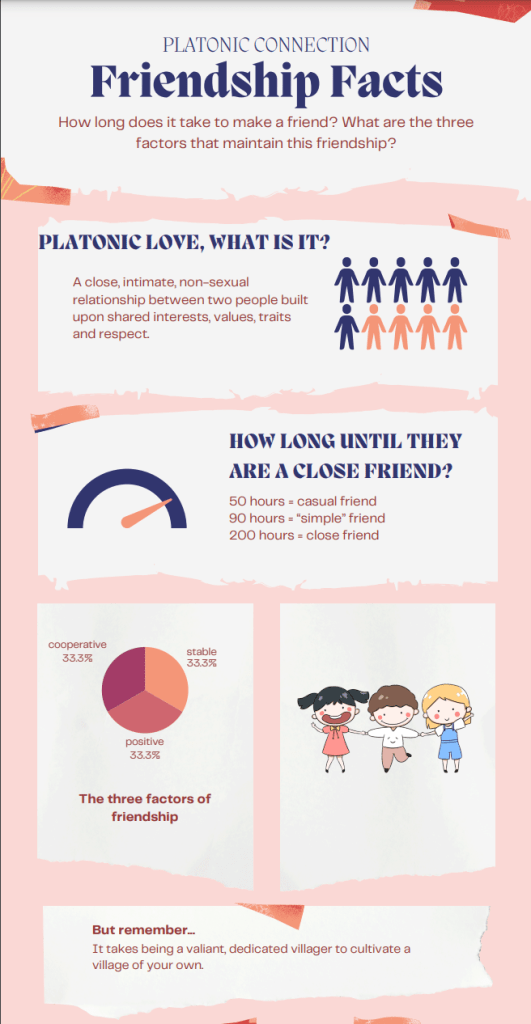
“It has to have these minimum three things: It’s a stable, longstanding bond; it’s positive; and it’s cooperative—it’s helpful, reciprocal, I’m there for you, you’re there for me,” said Denworth.
Friendship is the backbone of our support systems. It is proof that we are not just beings attached by blood, but beings attached by the learning of our souls. According to a study done by Associate Professor of Communication Studies, Jeffery Hall, it takes 50 hours together to move from mere acquaintance to casual friend, 90 hours until they are a simple friend, and 200 hours before they can be considered a close friend. While this science of 200 hours may be fairly accurate and agreed upon, it is important to acknowledge that it takes a lifetime to maintain said friendship. Platonic love is ongoing, if we want a village, we must be willing to be a villager for eternity.
 Moments with Maeve
Leave a Reply